How to Choose the Right Tile for Florida Bathrooms: What Works, What Doesn’t
A tile showroom can feel like a design magazine come to life. The formats, finishes, and color palettes available in 2026 make bathroom tile more visually exciting than ever. But in a Sarasota bathroom — where humidity, steam, and moisture are daily realities — the tile choices that look best in a showroom and the choices that perform best in Florida’s climate are not always the same thing.
The decisions that matter most are not always obvious when you’re holding a sample. Which zone of the bathroom is the tile going into? What finish handles wet feet safely? Is the grout you’re planning the right type for Sarasota’s conditions? And why is the tile specification for your shower floor different from the tile for your main bathroom floor?
Our team at Bob’s Carpet & Flooring (bobscarpetmart.com) on S. Tamiami Trail in Sarasota works with homeowners on these decisions every week — from barrier island condos to Lakewood Ranch and Palmer Ranch homes. Book a free in-home estimate at bobscarpetmart.com/services/free-in-home-estimates and we’ll walk your specific bathroom layout before you order a single tile.
Start Here: Porcelain, Not Ceramic, for Florida Bathroom Floors
Quick Answer — Florida Bathroom Tile Specification:
- Material: Porcelain tile (water absorption < 0.5% per ANSI A137.1)
- Finish: Matte or lightly textured — never high-gloss on floors
- Slip resistance: Wet DCOF of 0.42 or higher (ANSI A326.3) for main bathroom floors; 0.6 or higher for shower pan floors
- Surface hardness: PEI rating of 3 minimum; PEI 4 preferred for busy family bathrooms
- Grout: Epoxy grout for all wet-zone applications — no sealing required
- Shower pan: Small-format mosaic (2×2 or smaller) with matte/textured finish — not large-format
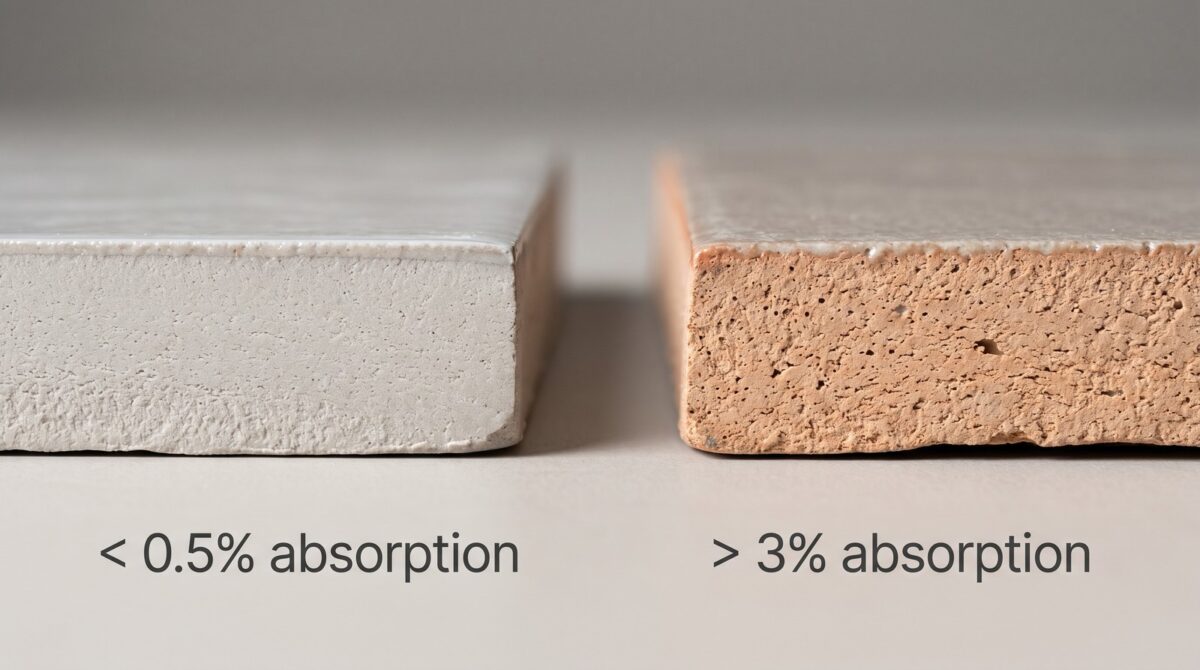
Porcelain and ceramic are both ceramic tile products made from clay-based materials, fired in a kiln, and often visually identical in a showroom display. The difference is in the firing process and the resulting density. Porcelain is fired at significantly higher temperatures using more refined clay, producing a tile body that is denser and harder than standard ceramic. Per the ANSI A137.1 standard, porcelain tile has a water absorption rate of less than 0.5 percent. Standard ceramic tile absorbs between 3 and 7 percent.
In a Sarasota bathroom exposed to daily steam, humidity above 70 percent, and occasional standing water, that absorption difference matters significantly over time. Ceramic tile that absorbs moisture at the body level allows moisture infiltration that promotes mold growth in grout joints and behind the installation layer. In a bathroom adjacent to Florida’s outdoor humidity sources, ceramic bathroom floor tile has a materially shorter lifespan than porcelain.
For Florida bathroom floors: porcelain only. Ceramic tile is appropriate for bathroom walls and vanity backsplash areas where moisture exposure is indirect — not for floors or shower surfaces where daily water contact is inevitable. For tile surface hardness, look for a PEI (Porcelain Enamel Institute) rating of 3 or higher for residential bathroom floors — PEI 4 is preferred for a busy family bathroom. PEI 0 and PEI 1 tiles are wall-use only and should never be specified for floors.
Pro-Tip from the Bob’s Carpet & Flooring Team in Sarasota:
At our S. Tamiami Trail showroom, we see two common mistakes in tile selection for Sarasota bathrooms.
The first is choosing ceramic for bathroom floors to save money. In our climate, the cost difference disappears quickly when the ceramic begins absorbing moisture and showing mold at the grout joints within two to three years.
The second is choosing a high-gloss porcelain for bathroom floors for its appearance. Gloss finishes look stunning in photographs but become dangerously slippery when wet. In a Sarasota bathroom where towel-fogged mirrors are a morning routine, a matte or textured finish is the right specification — always.
The Critical Distinction: Main Bathroom Floor vs. Shower Pan Floor
This is where most tile guides oversimplify, and where real installation mistakes happen. The main bathroom floor and the shower pan floor are different applications requiring different tile formats and different slip-resistance ratings.
Main bathroom floor: Large-format porcelain is ideal — 24×24, 24×48, or larger formats are the dominant trend in Sarasota bathroom renovations in 2026. Fewer grout lines mean less maintenance, a cleaner aesthetic, and in smaller bathrooms, an expanded visual scale. The slip-resistance requirement for a main bathroom floor calls for a wet Dynamic Coefficient of Friction (DCOF) of at least 0.42, per the ANSI A326.3 standard. A matte or lightly textured porcelain in a large format meets this threshold easily. Rectified porcelain — cut to very precise dimensions — allows 1/16 inch minimum grout joints for a seamless look; non-rectified tile typically requires 1/8 inch or more to accommodate dimensional variation.
Shower pan floor: The shower pan is a different environment. It’s in constant water contact during use, it must slope toward a drain, and it needs higher slip resistance because it’s used by wet bare feet. Large-format tile on a shower floor — unless installed by an experienced tile setter with precision back-buttering and a linear drain — creates pooling risk, potential tile cracking from inadequate support, and reduced traction. Back-buttering — applying thin-set mortar to both the substrate and the back of the tile — is required for proper bond coverage on large-format tiles and is non-negotiable on shower pan floors. Most tile professionals recommend a wet DCOF of 0.6 or higher specifically for shower floors.
For shower pan floors: smaller-format tile (2×2 mosaic, penny tile, or small hexagon) is the practical and safe choice. More grout lines mean more traction, better slope conformance to the drain, and a finished look that reads as intentional design. Porcelain and natural stone mosaics with a matte or textured finish are the standard recommendation for Sarasota shower pans.
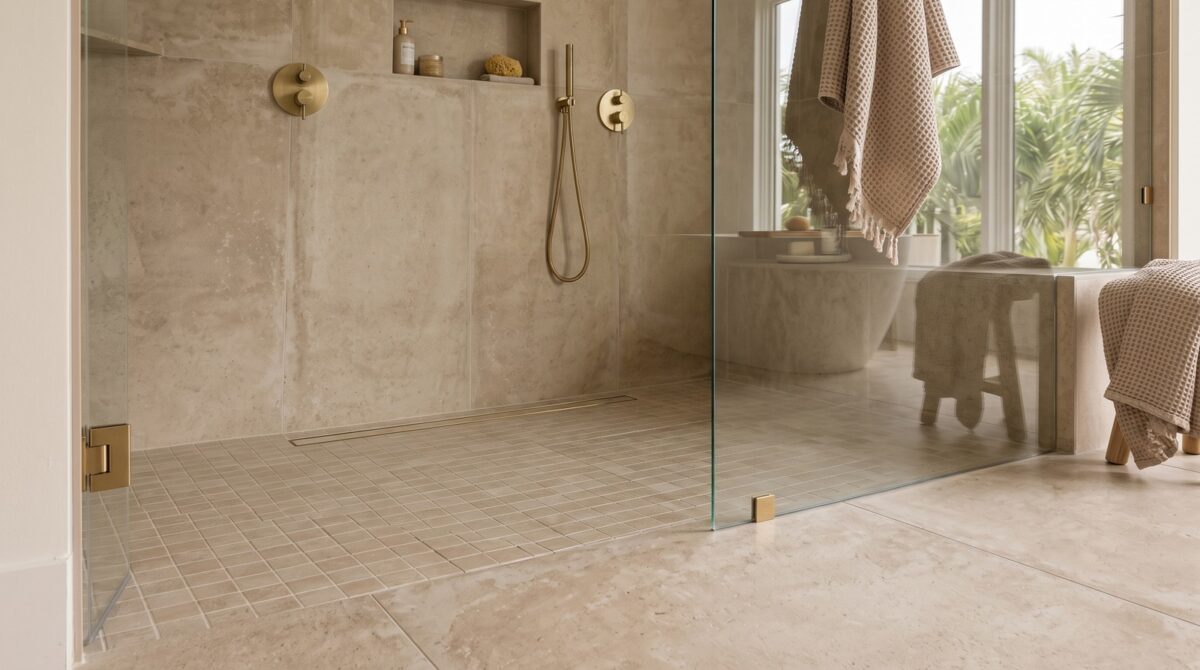
The combination that works best in a Sarasota master bathroom: large-format porcelain on the main bathroom floor (24×24 or larger) transitioning to small-format mosaic on the shower pan. The format contrast is intentional and visually interesting — designers in the Lakewood Ranch and Palmer Ranch market use it regularly as a deliberate choice.
Grout: The Decision That Outlasts the Tile
A well-specified tile can underperform in a Florida bathroom not because of the tile itself but because of the wrong grout. Standard cement grout is porous — in a Sarasota bathroom, it absorbs moisture, develops mildew, and stains without regular sealing maintenance. Epoxy grout is non-porous, stain-resistant, and requires no sealing. It is the appropriate specification for Florida bathroom floors, shower pans, and any wet-zone grout joint. Use neutral pH cleaners on epoxy grout — alkaline grout cleaners can degrade the epoxy bond over time.
For grout joint width: rectified porcelain allows 1/16 inch minimum joints for a near-seamless look; non-rectified tile requires 1/8 inch or more to accommodate dimensional variation. For 24×24 or larger tile, 1/8 inch with epoxy grout is a reliable specification that balances aesthetics and installation practicality.
On grout color: in Sarasota’s humid climate, mid-tone or tile-matched grout hides normal soiling and is more forgiving for maintenance than stark white or light grout in a heavily used bathroom. For high-contrast design schemes, plan for more attentive cleaning.
2026 Tile Trends for Sarasota Bathrooms
The Sarasota bathroom renovation market in 2026 is moving toward warm, organic aesthetics and simplified maintenance — a natural fit for Florida’s coastal lifestyle.
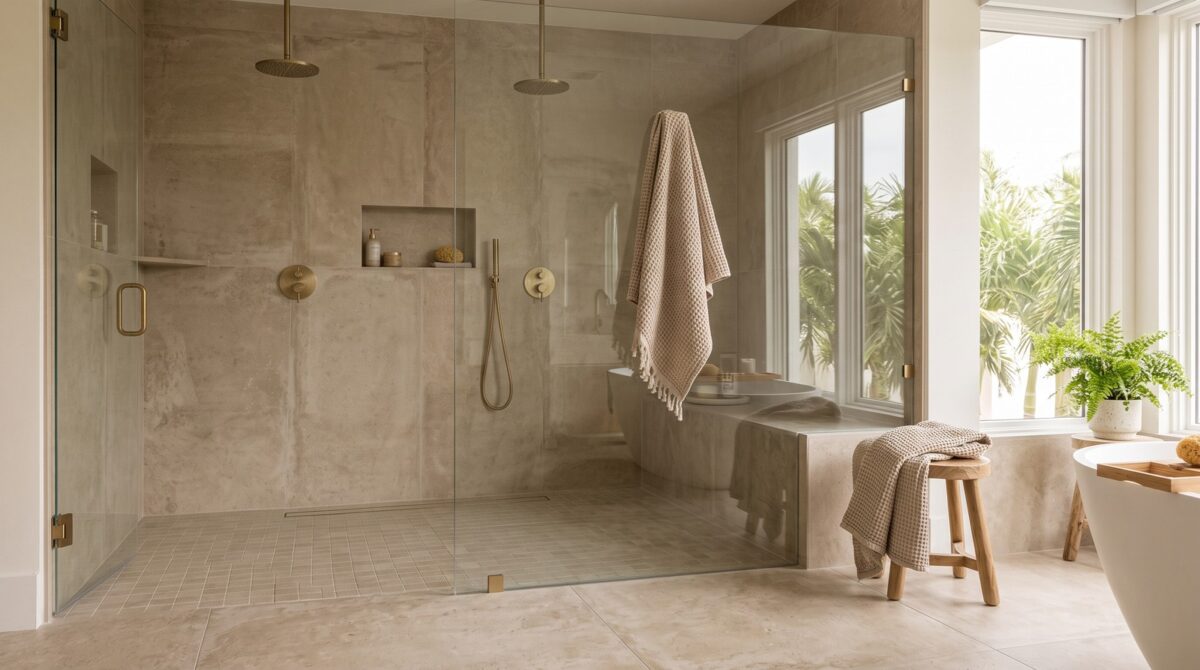
Large-format porcelain in 24×24, 24×48, and 32×32 formats is the dominant floor choice, reducing grout lines for both aesthetic and maintenance reasons. Warm beige, taupe, and natural concrete tones are replacing the cool grays that dominated for the past decade.
Tile “drenching” — running the same tile continuously from the floor up the walls and into the shower surround — creates an immersive, spa-like effect that works exceptionally well in Sarasota’s coastal aesthetic. The technique requires careful planning by an experienced installer but produces results that feel cohesive and refined in person.
Limewash and plaster-effect porcelain is emerging in Sarasota — porcelain manufactured to mimic the depth and variation of a plastered or limewashed wall, bringing organic warmth to bathrooms that plain glazed tile can’t replicate, while retaining porcelain’s moisture resistance.
Terrazzo-look porcelain — the soft-aggregate look pairs naturally with the light coastal palette and casual luxury aesthetic common in Sarasota barrier island condos and Palmer Ranch renovations.
“My experience with Bob’s Carpet Mart in Clearwater was excellent. The salesman worked within my budget and provided selections for a low, medium and higher quote. The installer did a fantastic job with difficult cuts around corners and tight spots.”
Tampa Bay Homeowner — Tile Flooring, Whole House
What to Avoid in a Florida Bathroom Tile Renovation
High-gloss porcelain on bathroom floors. Beautiful in photos, genuinely dangerous when wet. Glossy tile has lower traction than matte or textured tile regardless of the COF rating listed, because the finish reduces friction in real wet conditions. Gloss finishes are appropriate for walls and backsplashes — not floors.
Large-format tile on shower pan floors. Large tiles on shower pans create drainage challenges and traction concerns. Unless a linear drain is specified and a very experienced installer handles the back-buttering and setting, standard center-drain showers should use small-format tile on the shower pan.
Ceramic tile for bathroom floors and shower pans. The water absorption differential between ceramic and porcelain makes ceramic the wrong specification for Florida bathroom floors and wet zones. Ceramic is appropriate for bathroom walls.
Frequently Asked Questions: Bathroom Tile for Florida Homes
What’s the most important tile specification for a Sarasota bathroom floor?
Water absorption rate and slip resistance. For water absorption, porcelain at less than 0.5 percent per ANSI A137.1 is the correct specification for any Florida bathroom floor. For slip resistance, a wet DCOF of 0.42 or higher per ANSI A326.3 is the minimum for bathroom floors; 0.6 or higher for shower pan floors. Both specifications should be confirmed on the tile’s technical data sheet — not assumed from the product description or a showroom display.
How often do I need to seal grout in a Sarasota bathroom?
With cement grout, annually — and even with annual sealing, discoloration and mildew in grout joints are common in Florida’s humid bathroom environment. With epoxy grout, sealing is not required. Epoxy grout is the appropriate specification for Florida bathroom floors, shower pans, and any horizontal wet-zone application. Use neutral pH cleaners with epoxy grout to protect the bond over time.
What tile size works best in a small Sarasota bathroom?
Large-format tile (18×18 or larger) in a small bathroom creates the visual illusion of a more spacious room by reducing grout lines and allowing the eye to travel across the surface without interruption. This is counterintuitive — many homeowners assume smaller rooms need smaller tiles — but it’s consistent with how professional designers specify tile in Sarasota’s smaller coastal condos and guest bathrooms. On the shower floor in any sized bathroom, use mosaic tile (2×2 or smaller) for safety, regardless of the main floor tile size.
Is natural stone tile a bad idea for a Florida bathroom?
Not inherently, but for homeowners prioritizing maintenance ease, stone-look porcelain is the practical alternative. Natural marble and travertine must be sealed on installation and annually thereafter, and even sealed stone can etch from acidic cleaning products or develop moisture staining in high-humidity conditions. Dense honed granite or quartzite are more maintenance-friendly natural stone options than marble or travertine in Sarasota’s climate, if you specifically want real stone.
Should I use the same tile on the bathroom floor and the shower walls?
Using the same porcelain tile on the bathroom floor and shower walls creates the cohesive “tile drenching” look trending in 2026. A textured or matte large-format porcelain on the main floor and shower walls, with a complementary small-format mosaic on the shower pan, is a specification our Sarasota team executes regularly in Palmer Ranch and Lakewood Ranch renovations. Confirm the tile is rated for both floor and wall use — most floor-rated porcelain can be used on walls; wall-only rated tile should not be used on floors.
Your Sarasota bathroom tile decision is one of the highest-impact choices in any renovation — and Florida’s climate makes it more consequential than in most markets. Visit our showroom at 7261 S. Tamiami Trail in Sarasota to see our full tile collection in large-format samples, or request a free in-home estimate at bobscarpetmart.com/services/free-in-home-estimates and let our team walk your specific bathroom layout.
Call 941-921-6092 — same-day appointments are often available.