LVP Flooring on Lanais and Florida Rooms: What You Need to Know
It comes up at our Venice showroom on the Tamiami Trail almost every week. A homeowner is installing LVP throughout the main house and wants to extend it seamlessly into the lanai or Florida room. The question sounds simple. The answer isn’t.
Whether LVP works in an outdoor-adjacent space depends entirely on the specific conditions of that space: how it’s enclosed, whether it’s climate-controlled, how much direct sun it receives, and how the floor connects to the main interior. Get those conditions right and LVP performs well. Get them wrong and you’re looking at a warped, faded floor that no warranty will cover — because the installation exceeded the product’s rated conditions.
Our team at Bob’s Carpet & Flooring in Venice has assessed these spaces in South Venice ranch homes, Wellen Park new builds, and everything in between. Here’s the full picture. Book a free in-home estimate and we’ll walk your specific space before you make any decisions.
The Core Issue: LVP Is an Indoor Product
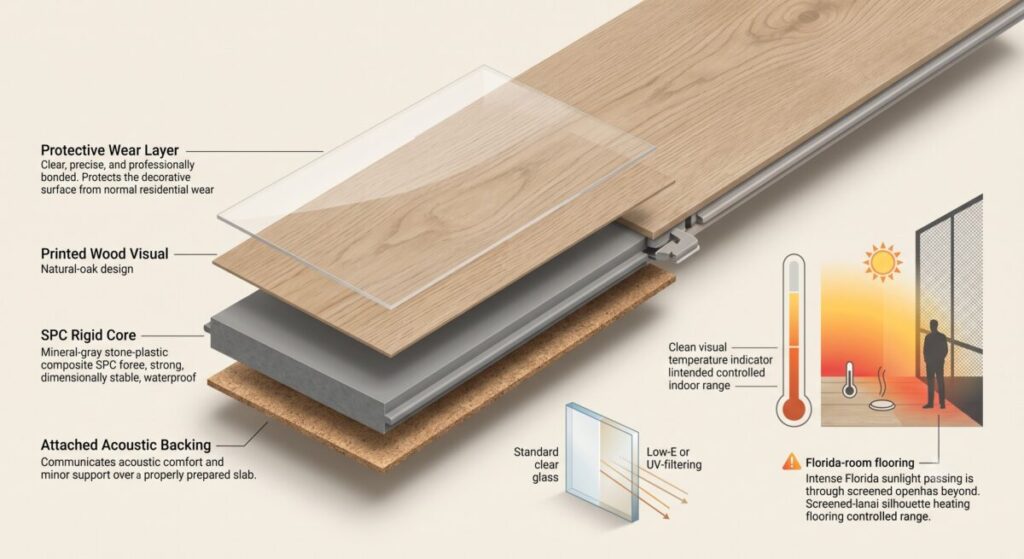
Standard LVP — including premium SPC (stone-plastic composite) rigid-core products — is engineered and warranted for interior, climate-controlled use. The manufacturer’s warranty on virtually every mainstream LVP product specifies installation in conditioned spaces with temperature and humidity ranges that reflect an occupied, HVAC-regulated interior.
Two performance factors drive this limitation. First, temperature extremes: SPC rigid-core LVP handles temperature variation better than older WPC (wood-plastic composite) products, but it still expands and contracts with thermal changes. In a fully climate-controlled interior, those changes are small and predictable. In a Sarasota County lanai in August without air conditioning, the surface temperature of the flooring material itself — as measured directly on the floor surface — can exceed 130 to 140 degrees Fahrenheit on a sunny afternoon. That’s outside any standard LVP product’s rated in-service ambient range of approximately 55 to 95 degrees Fahrenheit. The result is expansion beyond designed parameters, joint stress, and in some cases permanent deformation.
Second, UV exposure: the wear layer and surface film on standard LVP is not designed for sustained UV radiation. Even through a screen or under a roof overhang, consistent direct-sun exposure over months causes color fading and surface breakdown. Most manufacturers void the warranty for any installation that involves UV exposure from outdoor openings.
The line between “this works” and “this doesn’t” isn’t the word lanai or Florida room. It’s whether the space is climate-controlled, UV-protected, and enclosed.
| Pro-Tip from the Bob’s Carpet & Flooring Team in Venice: In Wellen Park and South Venice, we see two very different types of outdoor-adjacent spaces. Wellen Park new builds often have enclosed, glass-doored Florida rooms that are fully air-conditioned extensions of the main living area. South Venice ranch homes typically have traditional screened lanais — open to outdoor air, unconditioned, and subject to direct afternoon sun. The flooring answer for those two spaces is completely different, even if both are called a “lanai” by the homeowner. |
When LVP Can Work: The Conditioned Florida Room
A fully enclosed, climate-controlled Florida room is a legitimate LVP installation environment. For LVP to be appropriate, the space must meet all four of the following conditions:
| The 4 Conditions Required for LVP in a Florida Room: 1. FULLY ENCLOSED: Solid walls and ceiling that seal the space from outdoor air, with exterior-grade doors or windows that can be closed. A screened porch with mesh panels that allow outdoor air circulation does not qualify, regardless of roof coverage.2. CLIMATE-CONTROLLED: A dedicated HVAC supply and return that maintains indoor temperature between 55 and 95 degrees Fahrenheit year-round. A portable AC unit that runs intermittently is not sufficient.3. UV PROTECTED: Windows with low-E glass or UV-blocking film, or sufficient roof overhang to prevent direct sun from reaching the floor surface. Standard glass without UV protection allows enough UV transmission to degrade LVP wear layers over time.4. SLAB PREPARED: A concrete slab requires in-situ relative humidity testing per ASTM F2170 and moisture mitigation if readings exceed manufacturer thresholds — the same protocol as any other slab LVP installation. |
When all four conditions are met, SPC rigid-core LVP is a reasonable choice for a Florida room. The floor reads as continuous with the main interior and performs within the product’s rated parameters.
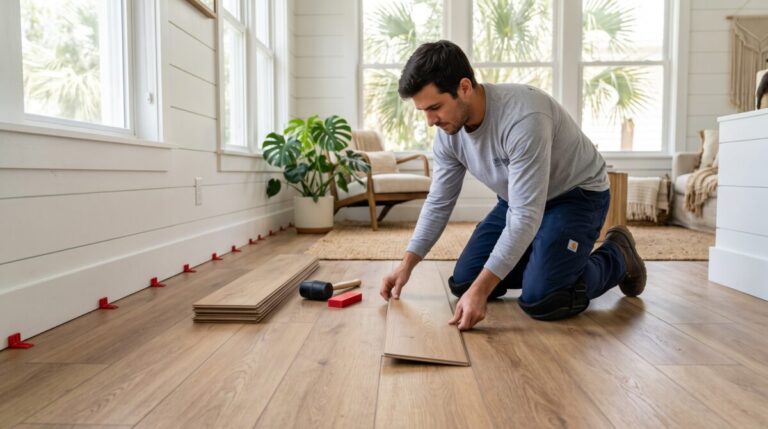
One critical installation detail even in a conditioned Florida room: expansion gaps of at least 3/8 inch at all walls, doorframes, and fixed vertical surfaces are required — and should be generous to account for temperature variation when exterior doors are opened. A Schluter or T-bar transition strip at the threshold between interior and Florida room is the standard professional detail. If UV exposure is a borderline concern — for example, standard glass without low-E coating — UV-protective film can be added to the windows as a mitigation step, but confirm with your product manufacturer whether this satisfies warranty requirements before proceeding.
When LVP Does Not Work: The Screened Lanai
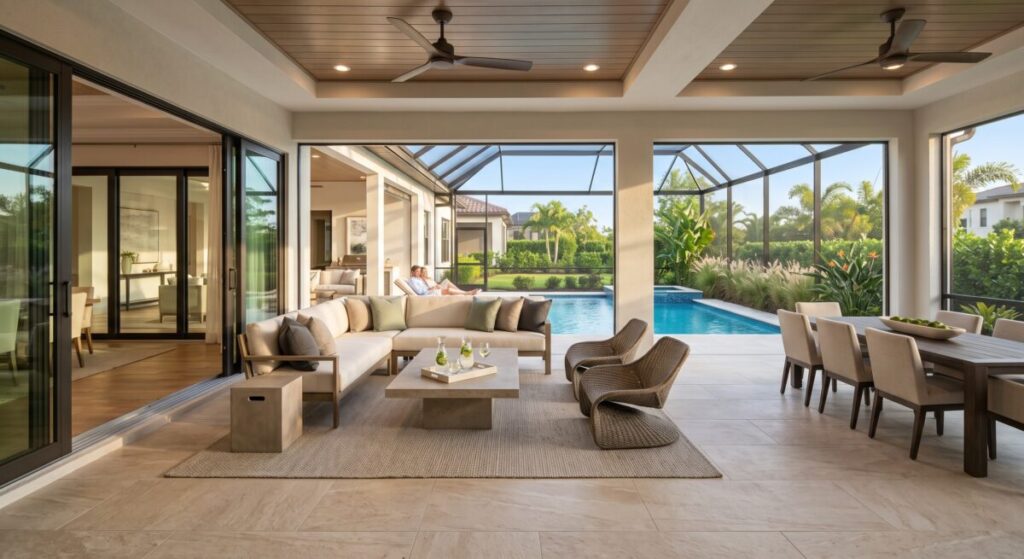
The traditional screened lanai found in most Venice and South Venice homes — a concrete slab, screen-and-frame enclosure, and a roof but no walls — is not a conditioned space. On a July afternoon in Venice, the air inside a screened lanai is effectively outdoor air: 90 degrees and 85 percent humidity. There is no HVAC supply. UV reaches the floor through screen panels for part of the day.
Installing standard LVP in this space is outside the product’s rated conditions. The expansion from temperature and humidity cycles, the UV exposure, and the absence of climate control will lead to joint separation, warping, edge lifting, and color degradation. The manufacturer’s warranty will not cover these failures. And in every case our Venice team has investigated, it’s not the product’s fault — it’s that the product was used outside its rated application.
The Right Flooring for a Screened Lanai in Venice
If you have a traditional screened lanai and want a finished floor beyond bare concrete, products rated for this application exist and perform well.
Porcelain tile is the most common and most appropriate choice. It handles temperature extremes without movement, is UV-stable, and is rated for outdoor installation. Our Venice team handles lanai tile installations from slab preparation through grouting, and we can help you select a large-format porcelain in a concrete or stone look that pairs with your interior LVP rather than attempting to match it exactly. The visual relationship between coordinated tile and interior LVP is intentional and looks designed when the tones complement each other.
Outdoor-rated composite deck tiles are another option for screened lanais where a floating installation over existing concrete is preferred. Sealed or painted concrete remains a functional, low-maintenance solution for older South Venice homes where the lanai is a transitional outdoor space rather than an extension of the living area.
What to avoid regardless of marketing language: standard LVP, standard laminate, and standard engineered hardwood are all wrong products for an unconditioned screened lanai.
“My experience with Bob’s Carpet Mart in Clearwater was excellent. The salesman worked within my budget and provided selections for a low, medium and higher quote. The installer did a fantastic job with difficult cuts around corners and tight spots.”
Tampa Bay Homeowner — Tile Flooring, Whole House
Making the Interior-to-Lanai Transition Work
Whether you’re installing LVP in an enclosed Florida room or porcelain tile in a screened lanai, the transition between the interior floor and the outdoor-adjacent space is one of the most important details in the project.
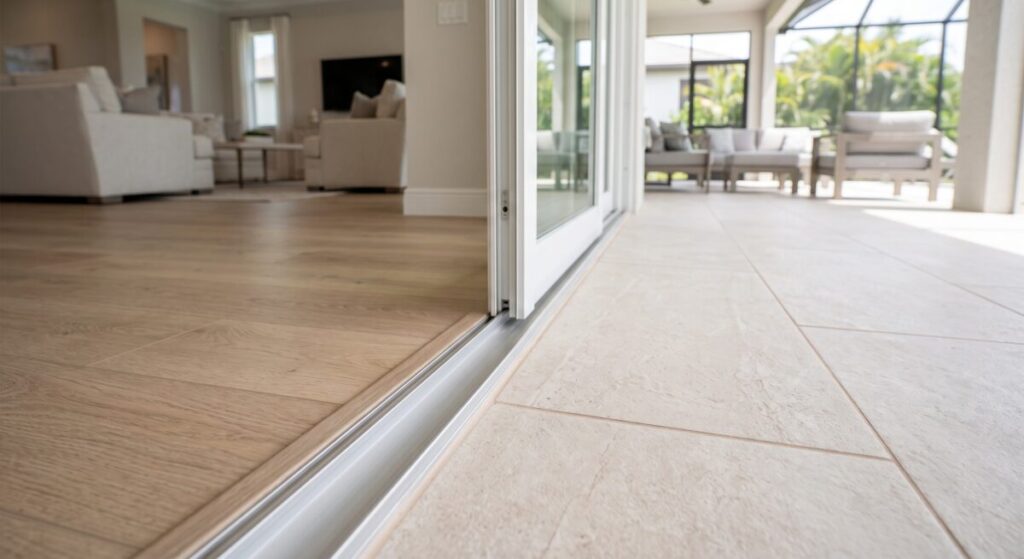
For a conditioned Florida room with LVP: a coordinated T-bar transition strip at the threshold creates a clean visual break between interior and Florida room materials. If the products are identical and the Florida room’s conditions have been confirmed within rated parameters, some installers run them continuously — but this requires explicit confirmation that every condition is met, including UV protection.
For a screened lanai with porcelain tile: a Schluter strip or coordinated aluminum threshold at the sliding door creates a clean handoff between interior LVP and exterior tile. The visual contrast between interior LVP and a complementary tile is intentional — it looks designed, not mismatched.
Our Venice team handles these transitions on every lanai-adjacent project and can walk you through the specific threshold detail for your home during the free in-home estimate.
“I would highly recommend Bob’s Carpet Mart to anyone who is looking to purchase new flooring. Their selection was the best around by far and their showroom was immaculate. The installers were very professional and did an outstanding job. They were on time and cleaned up very well.”
Tampa Bay Homeowner — Flooring Installation
Frequently Asked Questions: LVP on Lanais and Florida Rooms
Can I run the same LVP from my living room straight into my Florida room?
Only if the Florida room is fully enclosed with solid walls and exterior-grade doors, climate-controlled by a dedicated HVAC supply, and protected from direct UV exposure with low-E glass or sufficient roof overhang. If all three conditions are confirmed, running the same SPC LVP continuously is a viable installation with proper expansion gaps. If any condition is unmet, the Florida room portion will fail outside the manufacturer’s warranty. Our Venice team assesses these conditions during every free in-home estimate for lanai and Florida room projects.
Can you put LVP on a screened lanai in Venice?
No. A screened lanai — even with a roof — is still an unconditioned, outdoor-air-adjacent space. The screen allows outdoor temperature, humidity, and indirect UV to affect the floor surface throughout the day. Without active climate control maintaining the indoor temperature range the product is rated for, standard LVP will expand, contract, and eventually fail in ways the warranty doesn’t cover. Porcelain tile is the appropriate product for a screened lanai and handles all of these conditions without issue.
What about “outdoor LVP” products I’ve seen advertised?
Some specialty outdoor vinyl products exist with enhanced UV resistance and extended temperature ratings. However, these are niche products that are rarely stocked at local flooring retailers and often carry shorter warranty terms and higher replacement risk than standard porcelain tile. A screened lanai in Venice still needs a product rated for the specific temperature and UV conditions of that space — and porcelain tile handles those conditions more reliably. Ask our Venice team if your space falls into a gray area; we’ll give you an honest assessment rather than a default recommendation.
Can porcelain tile run continuously from my lanai into the main house interior?
Yes, and it’s one of the cleanest visual solutions for a Venice home where the lanai and interior connect through wide sliding glass doors. Porcelain tile installed continuously from the lanai slab through the interior eliminates the transition detail entirely and creates a seamless indoor-outdoor look. The interior slab portion still requires the same moisture testing and preparation as any tile-over-slab installation — our Venice team handles this assessment as part of the free in-home estimate.
How do I know if my Florida room qualifies as a conditioned space for LVP?
Use the four conditions from this article as a checklist: (1) fully enclosed with solid walls and exterior-grade doors, not screens; (2) dedicated HVAC supply maintaining consistent temperature year-round; (3) UV-protected windows with low-E glass or sufficient overhang; (4) slab tested for moisture per ASTM F2170. If you’re uncertain about any of these conditions, schedule a free in-home estimate with our Venice team before purchasing any flooring — we’ll assess the space directly and give you a product recommendation based on actual conditions, not assumptions.
The lanai and Florida room question is one of the most locally specific flooring questions in the Venice market — and it deserves a specific answer based on your space, not a generic one.
Visit us at 1624 Tamiami Trail in Venice, request a free in-home estimate, or call 941-493-2708. We’ll walk your lanai or Florida room and give you a product recommendation based on its actual conditions.