Porcelain Tile vs. Luxury Vinyl Plank for Florida Kitchens: Which One Wins?
In most of the country, choosing between porcelain tile and luxury vinyl plank for a kitchen is mostly a matter of taste and budget. In Sarasota, it’s a performance question — and it has a more specific answer than the generic comparison guides online will give you.
Florida kitchens handle conditions that kitchens in other states never see. Sandy feet tracked in from Siesta Key. Humidity that spikes when the back door opens to a lanai. The occasional Gulf Coast storm that pushes water under a sliding door before anyone notices. This is the environment your floor has to survive for years, not just for a photo shoot.
Our team at Bob’s Carpet & Flooring on S. Tamiami Trail has installed kitchen floors in Palmer Ranch homes, Lakewood Ranch kitchens, and Siesta Key condos for decades. Here’s the honest breakdown. Book a free in-home estimate and we’ll walk your kitchen before you make a decision.
Why Sarasota Kitchens Are a Tougher Test Than Most
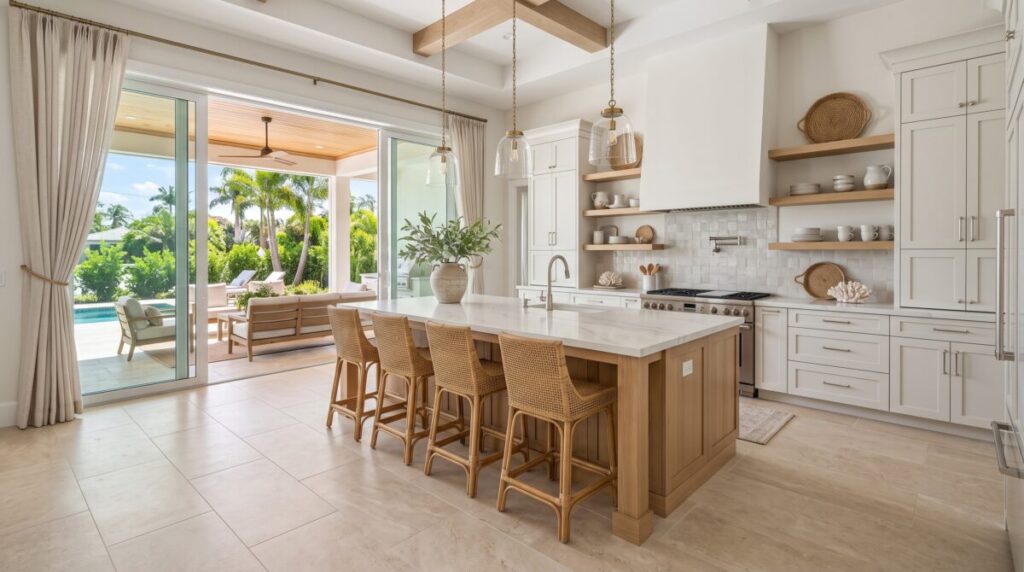
Sarasota sits at the intersection of Gulf Coast direct moisture exposure and the broader Suncoast humidity load. During summer months, outdoor humidity routinely exceeds 80 percent. Kitchens in homes that open to the exterior — through sliding glass doors, French doors to a lanai, or open windows — experience regular swings between controlled interior air and that outdoor moisture load.
The Sarasota kitchen also tends to be a hub of outdoor-indoor traffic. Homes in communities like Palmer Ranch, the Isles at Lakewood Ranch, and along the barrier islands of Siesta and Lido Key are built around outdoor living. The kitchen floor absorbs wet swimsuits, sandy feet, pool water, and the full force of a rainy August afternoon tracked through from the lanai.
Against that backdrop, both porcelain tile and premium LVP perform significantly better than any other kitchen flooring option. But they don’t perform the same way — and the difference matters depending on your household.
| Pro-Tip from the Bob’s Carpet & Flooring Team in Sarasota: The most common mistake in Sarasota kitchen floor decisions is choosing based on appearance alone. Both porcelain and LVP come in wood-look, stone-look, and large-format options that are visually nearly identical. The decision should come down to subfloor conditions, the kitchen’s proximity to water sources, and how the floor connects to outdoor spaces — not just which swatch looks better in the showroom. |
Where Porcelain Tile Wins in a Sarasota Kitchen
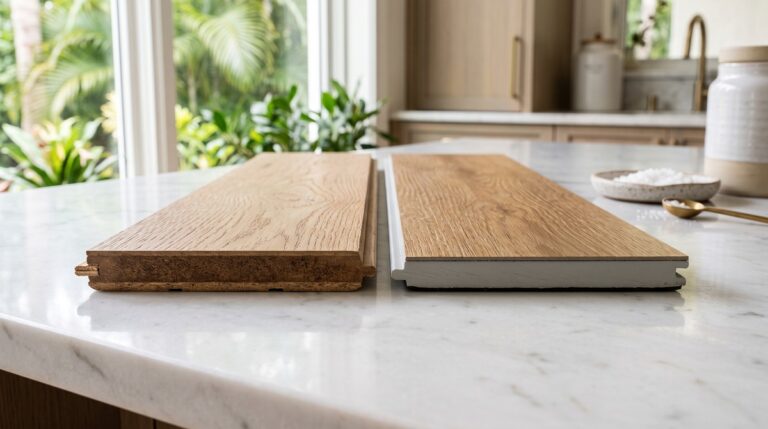
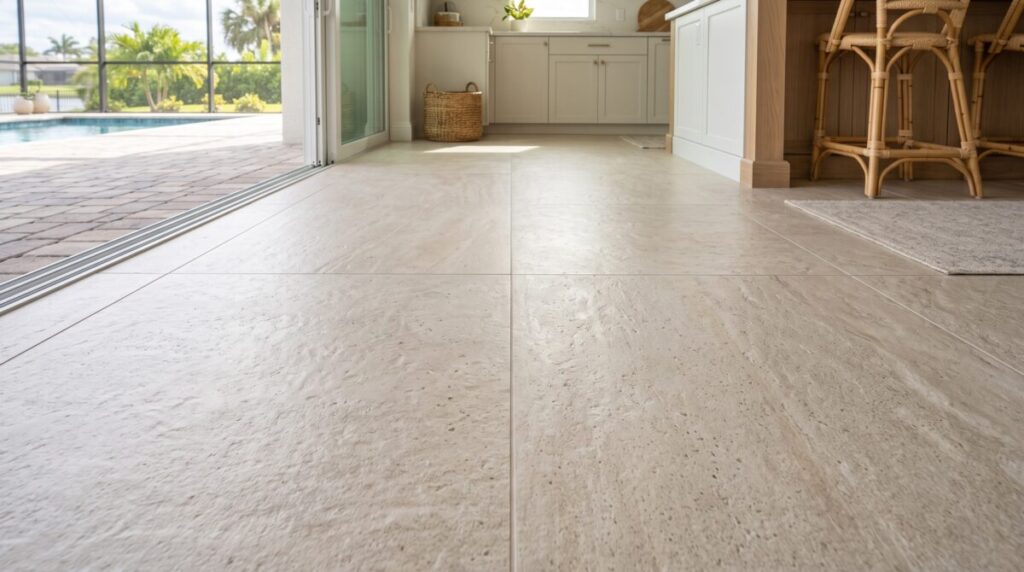
Porcelain tile’s core advantage is structural waterproofness. Porcelain is fired at extremely high temperatures to near-zero water absorption — less than 0.5% per the ANSI A137.1 standard, compared to 3% or more for standard ceramic tile. This distinction matters: when we recommend tile for a Florida kitchen, we mean porcelain specifically, not ceramic. Properly grouted and sealed porcelain is waterproof in a way that no LVP product, however excellent, can match at the structural level.
That matters most in three scenarios common to Sarasota kitchens. Appliance failures: when a dishwasher seal fails or a refrigerator ice maker leaks overnight, porcelain contains the water rather than allowing it to migrate under the floor and into the subfloor. Storm events: for homes in flood-prone areas near the Intracoastal or on the barrier islands, porcelain is the only kitchen floor that survives water intrusion without requiring full replacement. Longevity: a properly installed porcelain kitchen floor, with proper maintenance, is a 30-to-50-year floor. In a luxury home in a neighborhood like Bird Key or Longboat Key where resale value depends on high-quality finishes, that permanence has real worth.
| 2026 Sarasota Kitchen Tile Trends: Large-format porcelain continues to dominate — 24×24 inch formats and plank tiles (12×48 or 24×48) are the most requested at our Sarasota showroom. Herringbone-layout porcelain plank tile is trending sharply in Palmer Ranch and Lakewood Ranch renovations, adding visual movement to open-plan kitchens. Terrazzo-look porcelain is emerging as a coastal-contemporary choice for Siesta Key and Lido Key homes where a softer, more organic look complements the beachy palette. Both formats minimize grout lines while keeping a sophisticated, clean aesthetic. |
The tradeoffs with porcelain are also real. It is harder underfoot — standing at a kitchen island for two hours is more tiring on porcelain than on LVP. It is cooler to the touch, which many Sarasota homeowners appreciate in summer and some find cold in the morning. Grout lines require maintenance in a busy kitchen, though modern epoxy grout has reduced this burden significantly. Installation over a second-floor wood subfloor requires cement backer board and a deflection assessment — the Tile Council of North America (TCNA) specifies an L/360 deflection tolerance minimum before tile can be installed over wood — which adds time and cost.
Where LVP Wins in a Sarasota Kitchen
Premium SPC (stone-plastic composite) rigid-core LVP has moved far beyond its budget-alternative origins. The best SPC products are fully waterproof throughout the plank — not just at the surface — with wear layers of 12 to 20 mil. For a Sarasota kitchen with regular sandy foot traffic from the Gulf Coast lifestyle, a 20 mil wear layer is preferred. Shaw’s Floorte and Mohawk’s SolidTech collections [CONFIRM WITH DEALER] offer wide-plank options in light oak and driftwood tones that fit Sarasota’s coastal neutral palette well.
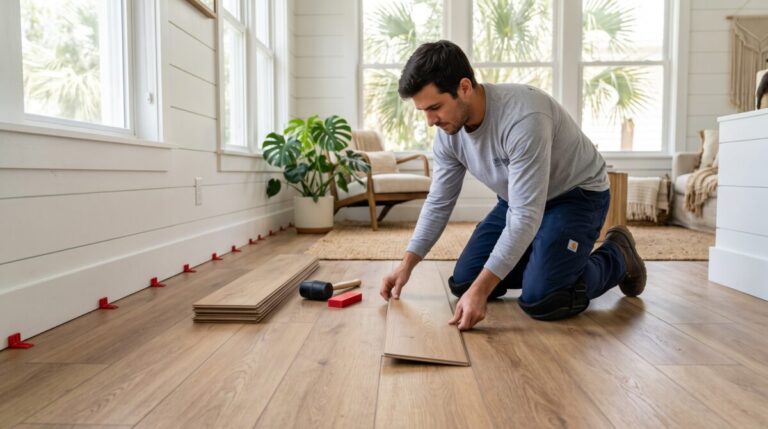
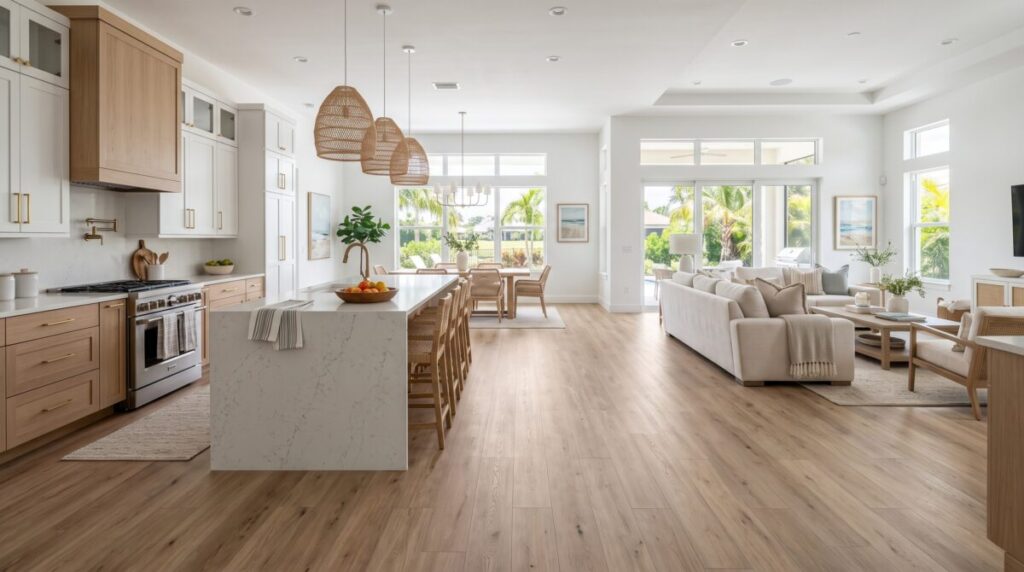
LVP’s core advantages in a Sarasota kitchen are comfort, continuity, and installation speed. Underfoot comfort: a meaningful difference in a kitchen used heavily for cooking and entertaining. Continuity: LVP runs seamlessly from kitchen through dining and living areas without transitions, which suits open-plan Sarasota home designs. Installation: a kitchen LVP job is typically complete in one to two days with minimal disruption, versus tile’s requirement for mortar set time and grout cure before the kitchen can be used again.
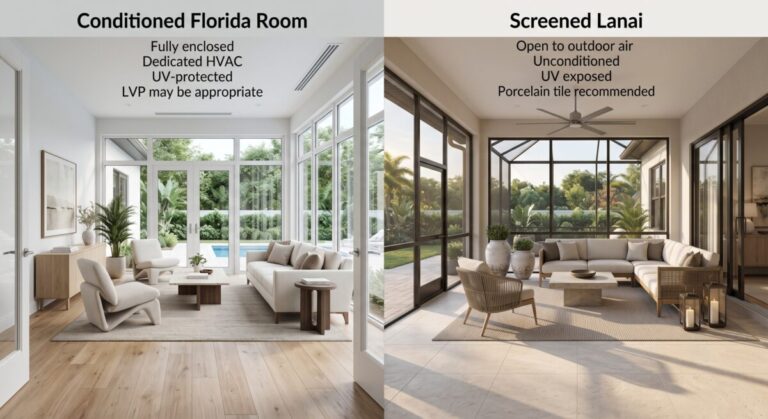
The meaningful limitation of LVP in a Sarasota kitchen is its behavior where the kitchen connects to outdoor spaces. LVP cannot extend into an unconditioned or semi-conditioned lanai — the temperature extremes of an exterior space in a Sarasota summer are outside its rated performance range. Where the kitchen transitions to an outdoor or screened lanai area, a flush-mounted aluminum threshold strip or Schluter profile is the correct transition solution, with porcelain tile or another rated exterior material continuing beyond it. Porcelain can run continuously from interior kitchen to covered outdoor kitchen — LVP cannot. For a home where that continuity is the design goal, porcelain is the right call.
“My experience with Bob’s Carpet Mart in Clearwater was excellent. The salesman worked within my budget and provided selections for a low, medium and higher quote. The installer did a fantastic job with difficult cuts around corners and tight spots.”
Tampa Bay Homeowner — Tile Flooring, Whole House
Which Is Right for Your Sarasota Kitchen?
Rather than a simple winner, think of it this way: the best kitchen floor for a Sarasota home fits the specific conditions of that kitchen.
Choose porcelain if:
Your kitchen is on a ground-floor slab in a potential flood zone. Your kitchen connects directly to a wet lanai or outdoor cooking area. You plan to stay in the home for 20 or more years and want a floor that outlasts every other remodeling decision you make. You’re in a luxury community where resale value depends on high-end finishes, such as Bird Key or Longboat Key.
Choose premium LVP if:
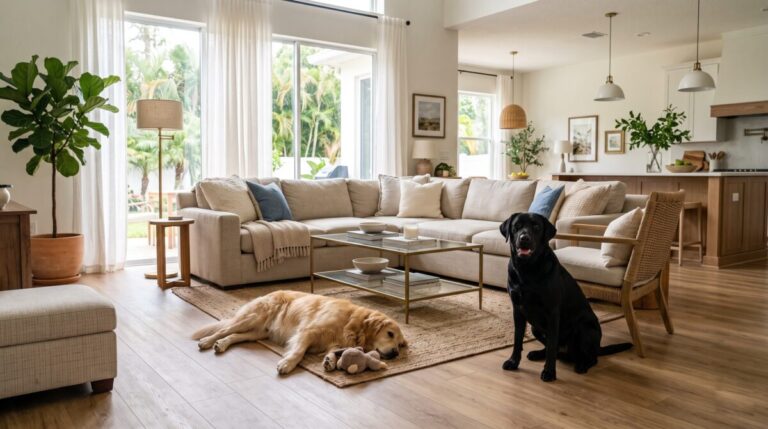
Your kitchen is in an open-concept home where flooring continuity through the living area matters most. You spend significant time cooking and prioritize underfoot comfort. Your project timeline doesn’t allow for the longer tile installation process. You’re renovating a contemporary home in Palmer Ranch or Lakewood Ranch where a warm wood-look aesthetic is the goal.
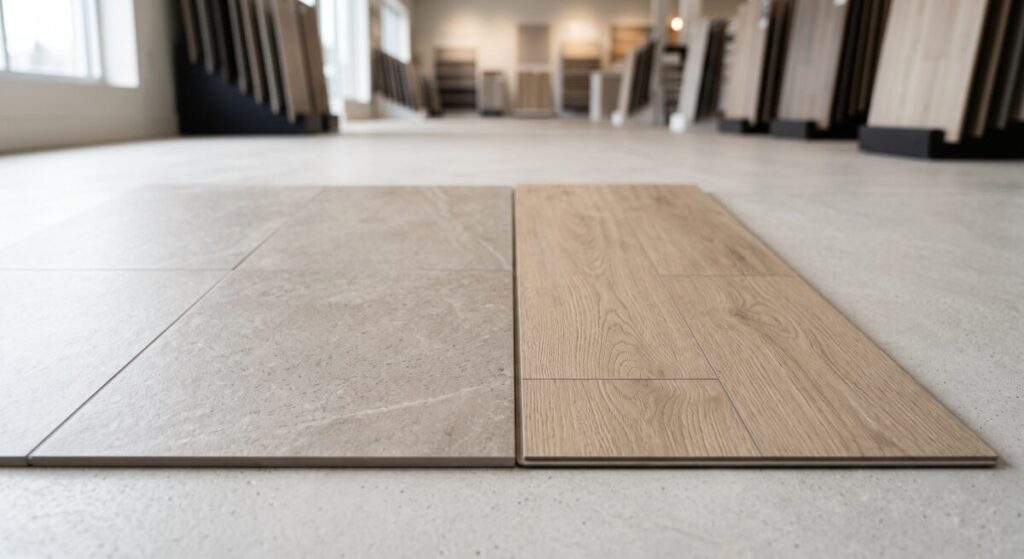
Before your visit, use the Roomvo Flooring Visualizer on our website to see both porcelain tile and LVP options inside a photo of your actual kitchen.
How to Choose a Flooring Installer for Your Sarasota Kitchen
Kitchen floors are not forgiving of installer shortcuts. Ask two questions before signing anything.
First: will you inspect the subfloor before installation? For tile, this means assessing deflection to the TCNA’s L/360 standard, flatness, and moisture. For LVP, it means checking for slab height variation that would cause the floating floor to flex at the joints. Either product installed over a compromised subfloor will underperform — and neither warranty covers it.
Second: how do you handle the kitchen-to-lanai transition? This is a Sarasota-specific question that separates experienced local installers from crews who don’t know the market. An experienced team has a ready answer — flush aluminum threshold, Schluter strip, tile continuation — before you finish asking. A crew that pauses is a flag.
Bob’s Carpet & Flooring has served Sarasota and the surrounding Suncoast communities since 1969. The Best Warranty in Town covers both product and workmanship — and our project specialists know the specific conditions in Palmer Ranch, Lakewood Ranch, and the barrier island communities that make kitchen floor decisions here different from anywhere else in the country.
“I would highly recommend Bob’s Carpet Mart to anyone who is looking to purchase new flooring. Their selection was the best around by far and their showroom was immaculate. The installers were very professional and did an outstanding job. They were on time and cleaned up very well.”
Tampa Bay Homeowner — Flooring Installation
Frequently Asked Questions: Tile vs. LVP for Florida Kitchens
Which lasts longer — porcelain tile or LVP in a Florida kitchen?
Porcelain tile, properly installed and maintained, is a 30-to-50-year floor. Premium LVP with a 20 mil wear layer is realistically a 15-to-25-year floor with normal residential use. In a Sarasota kitchen with high-volume cooking and sandy coastal traffic, porcelain holds a durability advantage over the long term. LVP, however, is easier and less disruptive to replace when that time comes, which is part of its appeal in a remodel context.
Can LVP run from the kitchen out to a Sarasota lanai or screened porch?
Not into an unconditioned or semi-conditioned space. Premium SPC LVP handles the temperature and humidity of a fully climate-controlled kitchen well, but the temperature extremes of an unconditioned Florida lanai in summer are outside its rated range. Where the kitchen meets the lanai threshold, use a flush aluminum transition strip or Schluter profile, with porcelain tile continuing into the outdoor space. For a covered, fully climate-controlled Florida room, LVP may be an option — discuss the specific space conditions with our Sarasota team before deciding.
Is grout maintenance a serious concern in a busy Sarasota kitchen?
Less than it used to be. Modern epoxy grout — which we recommend for all kitchen tile installations — is stain-resistant and does not require periodic sealing, unlike traditional cement grout. Combined with large-format porcelain tiles that minimize grout line surface area, a contemporary porcelain kitchen floor in Sarasota is genuinely low maintenance. Using a mid-tone grout color that doesn’t highlight everyday kitchen residue makes a practical difference. For homeowners who want zero grout concerns, LVP eliminates the question entirely.
Does porcelain tile feel too cold in a Sarasota kitchen?
The cool-surface quality of tile is subjective and somewhat climate-dependent. In Sarasota’s warm climate, a cool kitchen floor on a summer morning is rarely a negative — many homeowners specifically value the thermal quality of tile in a Gulf Coast kitchen. That said, underfoot comfort is a genuine LVP advantage, and it’s worth experiencing both surfaces in our Tamiami Trail showroom before deciding.
What size porcelain tile works best in a Sarasota kitchen?
Large-format tiles — 24×24 inches or larger, including plank formats of 12×48 or 24×48 — are the dominant choice in Sarasota kitchen remodels in 2026. They minimize grout lines, simplify cleaning, and suit the open-plan airy layouts common in Palmer Ranch and Lakewood Ranch homes. Herringbone-layout plank tile is trending for kitchens where the floor is meant to be a design focal point. Our Sarasota team can advise on the best format for your specific kitchen shape and subfloor conditions.
Your Sarasota kitchen floor decision is one of the highest-impact choices in any remodel — and it deserves more than a generic online comparison. Visit our showroom at 7261 S. Tamiami Trail in Sarasota, see both products in large-format samples under real Florida lighting, and let our team walk through your specific kitchen layout and lanai connection before you commit.
Request your free in-home estimate or call 941-921-6092. Same-day appointments are often available.