What Causes Hardwood Floors to Warp or Buckle in Florida? (And How to Prevent It)
Someone in your neighborhood has a story. Their hardwood floors looked beautiful for eighteen months and then started cupping at the edges, or buckled so badly they could see the gap between planks and the subfloor. They spent a lot of money. They’re still angry about it. And now you’re wondering whether hardwood is even a viable option in your Bradenton home.
Here’s what that story almost never includes: what actually went wrong. In nearly every case of hardwood floor failure in Florida, the cause isn’t the wood itself. It’s something that happened before the first plank was laid — a skipped moisture test, a missing vapor barrier, the wrong product over the wrong subfloor. Fix those things and hardwood performs beautifully in Florida for decades.
Our team at Bob’s Carpet & Flooring on 53rd Ave East in Bradenton has been installing hardwood floors in Manatee County homes since 1969. We know what fails and why — and we know how to prevent it. Book a free in-home estimate and we’ll test your slab before we recommend a single product.
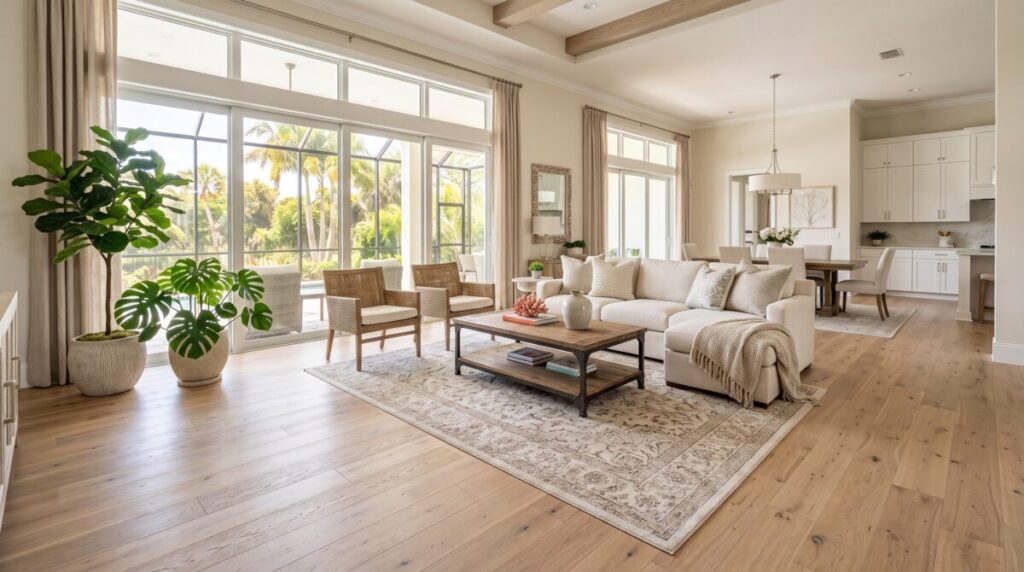
The Science Behind Warping: Why Wood Moves in Florida
Wood is hygroscopic — it absorbs and releases moisture from the surrounding air. When ambient humidity rises, wood absorbs moisture and expands across the grain. When humidity drops, wood releases moisture and contracts. This cycle is normal. Flooring manufacturers design their products with this movement in mind.
The problem in Florida is scale and consistency. Florida ranks among the most humid states in the country, with average relative humidity exceeding 74% annually. In Manatee County during summer months, outdoor humidity routinely reaches 85 to 90 percent. When the HVAC system maintains indoor humidity between 35 and 55 percent — the range the National Wood Flooring Association (nwfa.org) specifies as safe for hardwood — wood floors function as designed. When that range isn’t maintained, or when moisture migrates upward from the slab rather than from the air, the floor begins to fail.
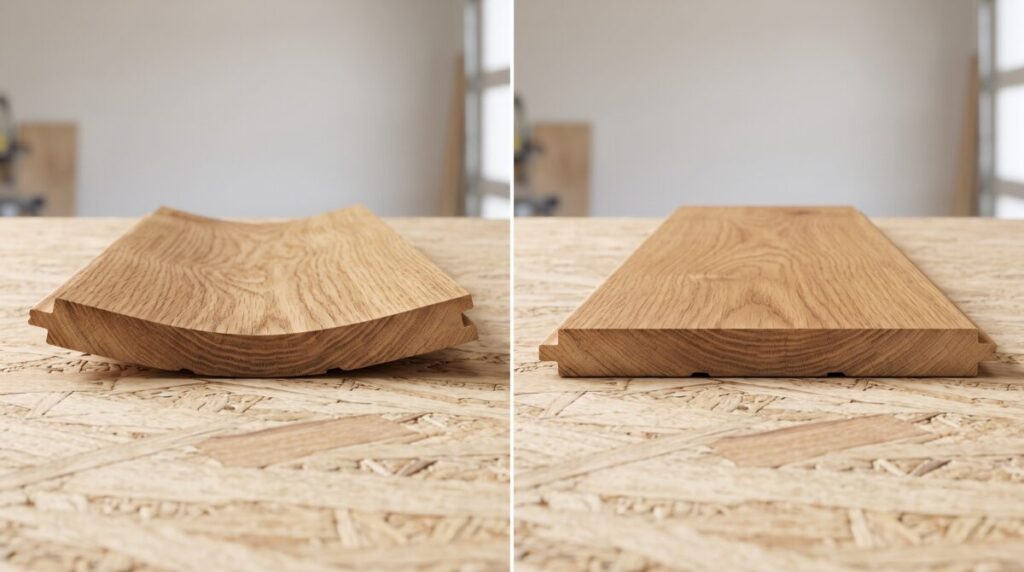
Cupping hardwood floors in Florida happens when plank edges absorb more moisture than the center, curling upward. Crowning is the reverse — the center rises above the edges. Buckling is the most severe form: planks lift completely off the subfloor, typically after chronic moisture exposure or a flooding event. Gapping happens when humidity drops too low and wood contracts, leaving visible spaces between planks.
In a properly conditioned Bradenton home with the right product and a proper installation, none of these happen.
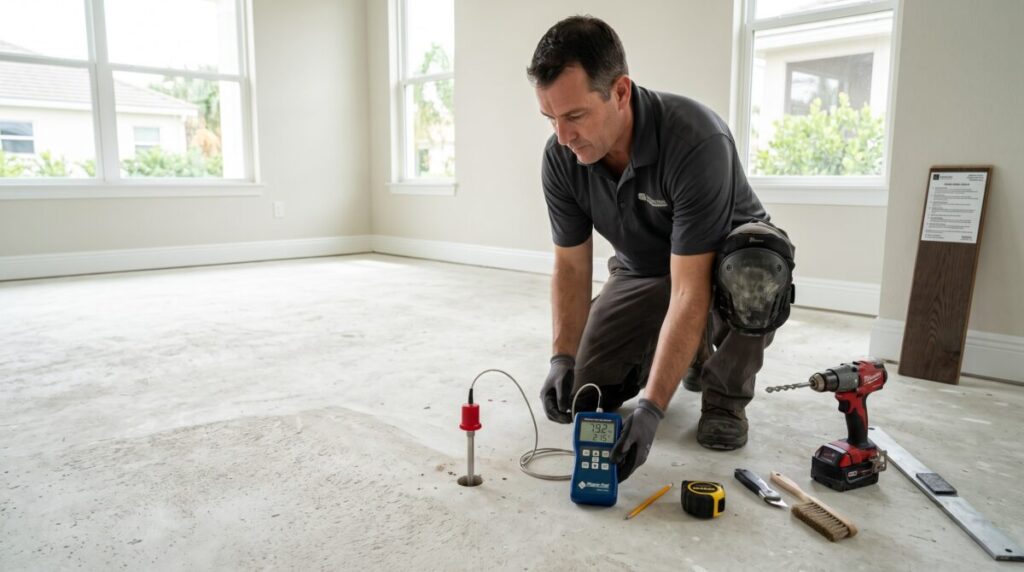
| Pro-Tip from the Bob’s Carpet & Flooring Team in Bradenton: The most common hardwood failure we see in older Bradenton neighborhoods along the SR-70 corridor and in Creekwood comes from homes where the original concrete slab has no vapor barrier. Slabs poured before modern moisture barrier requirements often emit vapor at rates exceeding the tolerance of wood flooring adhesives and engineered wood cores. We measure this before every installation using a relative humidity probe per ASTM F2170. If the number is too high for the product you want, we tell you — and we present solutions, starting with moisture mitigation before the floor goes down. |
The Four Root Causes of Hardwood Failure in Florida
| The Four Root Causes at a Glance: 1. SOLID HARDWOOD OVER CONCRETE SLAB: Solid wood lacks the cross-ply stability to handle Florida slab moisture vapor. Engineered hardwood is the correct product for slab installations.2. SKIPPED OR RUSHED MOISTURE ASSESSMENT: Surface pin meters are inadequate. In-situ RH testing per ASTM F2170 takes 24-72 hours and is the only reliable method for a Florida slab.3. NO MOISTURE MITIGATION WHEN NEEDED: A high moisture reading is not a dead end — it’s a signal for epoxy barrier coating or moisture-blocking adhesive before the floor goes down.4. INSUFFICIENT ACCLIMATION: 48-72 hours minimum in the installation environment with HVAC running at normal occupancy settings. Never skip or rush in a humid climate. |
1. Solid Hardwood Over a Concrete Slab
Solid hardwood is the wrong product for any first-floor installation over a concrete slab in Florida. Solid wood is a single piece of timber with no engineered stability layer, and it responds to moisture vapor migration from concrete far more dramatically than engineered wood. Most solid hardwood manufacturers strongly advise against slab installation in Florida’s climate, and the NWFA’s installation guidelines require specific moisture control protocols for any concrete slab application that Florida’s sustained humidity makes difficult to maintain reliably.
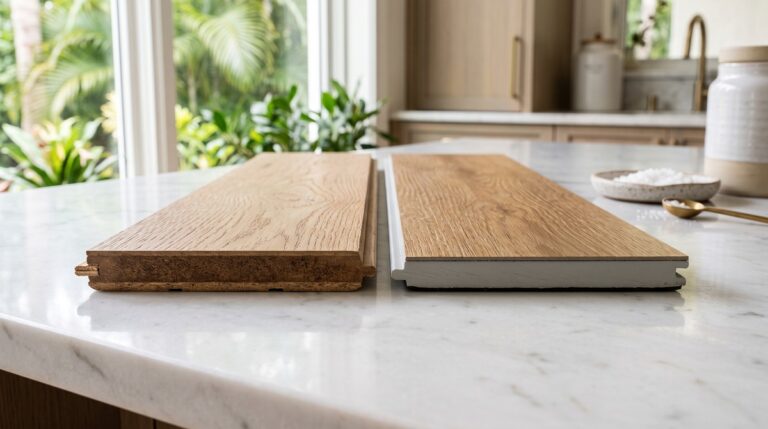
Engineered hardwood is a fundamentally different product. Its cross-ply core — typically HDF or multi-ply plywood bonded in alternating grain directions — resists the expansion and contraction that destroys solid wood over a Florida slab. It is specifically rated for concrete subfloor installation in high-humidity climates when the subfloor is properly prepared.
2. Skipping or Rushing the Moisture Assessment
This is the most common installation shortcut and the one that causes the most damage. A proper pre-installation moisture test using in-situ relative humidity probes per ASTM F2170 takes 24 to 72 hours to complete accurately. Surface pin meter readings are not an adequate substitute for a Florida slab. Most hardwood manufacturers specify a maximum of 75% RH using ASTM F2170, or no more than 3 lbs per 1,000 sq ft per 24 hours using the calcium chloride test (ASTM F1869), as the threshold for proceeding without additional moisture mitigation. If your installer’s “moisture test” is a quick pin reading taken on installation day, that’s a flag.
3. No Moisture Mitigation When One Is Needed
A high moisture reading doesn’t mean hardwood is impossible. It means hardwood requires additional preparation first. Moisture mitigation systems — epoxy barrier coatings applied directly to the slab surface, or moisture-blocking adhesives like Bostik’s moisture-resistant formulations [CONFIRM WITH DEALER which specific systems are stocked at this location] — reduce vapor emission to within product-rated tolerances. This is standard practice in Florida hardwood installations. Installers who present only two options — hardwood or nothing — are not showing you the complete picture.
4. Insufficient Acclimation Time
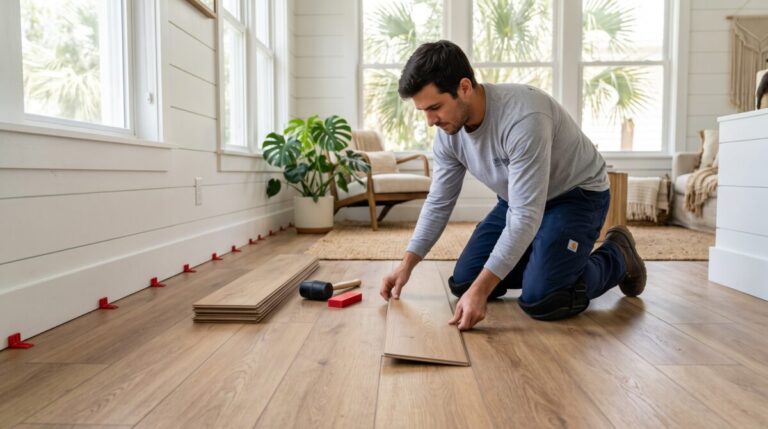
Engineered hardwood must stabilize to the temperature and humidity of its installation environment before it’s laid. In Bradenton’s summer conditions, most manufacturers require 48 to 72 hours minimum, with wider planks potentially needing five to seven days. A critical detail for Lakewood Ranch and Bradenton second-home owners: the HVAC must be running at normal occupancy settings during acclimation. If the home sits unoccupied without air conditioning between delivery and installation day, the acclimation environment may be entirely different from the normal living conditions — and the wood’s stabilization will be meaningless. An installer who delivers Monday and installs Tuesday is likely skipping this step in a way that matters.
Choosing the Right Engineered Hardwood for a Bradenton Home
For ground-floor hardwood installation in Manatee County, engineered hardwood is the right product category. Within that category, what matters most is core type, veneer thickness, and finish.
An HDF or multi-ply plywood core provides better dimensional stability than lower-density alternatives — ask specifically about core construction. A veneer of 3mm or thicker allows future refinishing, which can double the floor’s usable life. Aluminum oxide factory finishes provide the best humidity resistance for a Florida home. Species with tighter grain patterns — white oak, hickory, hard maple — are among the more stable choices for high-humidity markets.
Shaw Floors and Mohawk carry engineered hardwood collections rated for high-humidity climates, with core constructions and finish systems designed to perform in markets like Bradenton, Lakewood Ranch, Heritage Harbour, and the surrounding Manatee County communities [CONFIRM specific collection names available at this location].
“I would like to show my appreciation for the total replacement of our wood floors, 900 sq. ft, by Bob’s Carpet. The company stood by their word and my Wife and I couldn’t be happier. All of their employees and management were very helpful to resolve our issue.”
Jay, Tampa Bay Area — Wood Floor Replacement, 900 sq ft
Maintaining Engineered Hardwood in Bradenton’s Climate
Installation is only half of the equation. The NWFA recommends maintaining indoor relative humidity between 35 and 55 percent year-round for wood floors. In Bradenton during summer, this requires a functioning HVAC system and, in some homes, a supplemental dehumidifier. A basic hygrometer placed in the room with your hardwood floors lets you monitor conditions year-round. Readings regularly above 55 percent mean the HVAC needs attention before a flooring problem develops.
For routine cleaning: use a pH-neutral hardwood cleaner on a microfiber mop wrung nearly dry. Never use a wet mop. If a spill occurs, blot it immediately with a dry cloth — don’t let liquid sit on any wood surface, even for a few minutes. Standing water is one of the fastest routes to edge-swelling in an otherwise properly installed floor.
“My husband and I had a wonderful experience at Bob’s Carpet Mart! Our salesman was very helpful and made sure we got a fantastic deal on hardwood. Our installer was very courteous and did a beautiful job!”
Tampa Bay Area Homeowner — Hardwood Flooring
What to Ask Any Installer Before They Touch Your Bradenton Subfloor
Two questions separate a Florida-experienced hardwood team from one that isn’t.
First: will you conduct a full ASTM F2170 in-situ relative humidity test — not just a surface pin reading — and share the results before I approve the installation? Any qualified installer says yes immediately.
Second: what moisture mitigation options do you carry if the slab reading exceeds product tolerance? An experienced Bradenton team has a ready answer: epoxy moisture barrier coating, Bostik moisture-resistant adhesive systems [CONFIRM WITH DEALER], or both. A team that responds with “then we can’t do hardwood” hasn’t given you the full picture.
Bob’s Carpet & Flooring has served Manatee County for 57 years. Our Bradenton team at 53rd Ave East knows which older subdivisions have slab challenges and which newer Lakewood Ranch communities require specific preparation — institutional knowledge built over decades of installations in this exact market.
Frequently Asked Questions: Hardwood Floor Warping in Florida
My hardwood floors are already cupping. Is it too late to fix them?
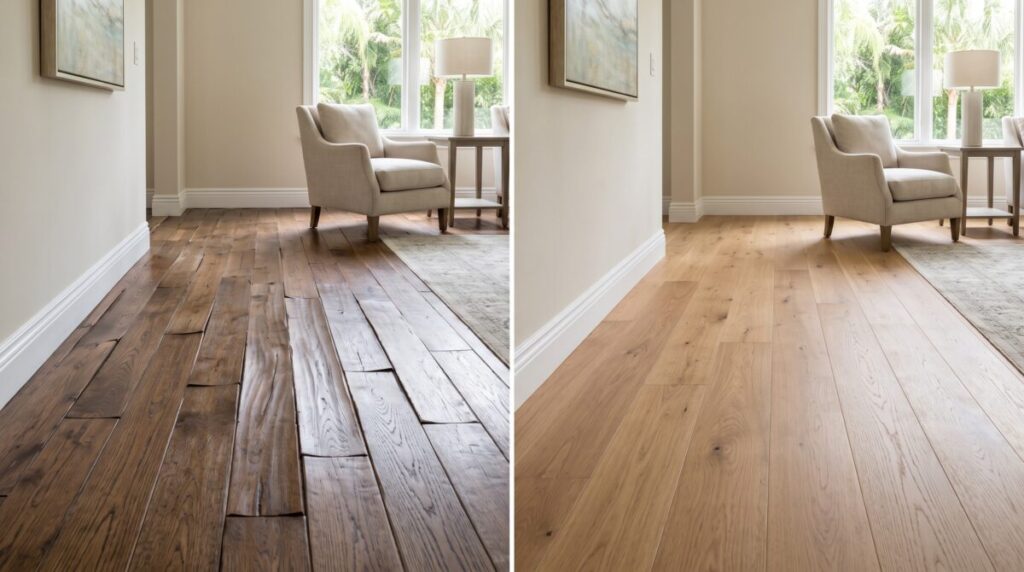
It depends on severity and cause. Mild cupping caused by elevated indoor humidity often reverses on its own when humidity is brought back to the 35-55% range. Moderate cupping sometimes responds to professional sanding after the moisture issue is resolved — but this requires sufficient veneer thickness and, critically, the moisture source must be eliminated before any sanding begins. Attempting to sand a cupped floor before fixing the humidity or slab moisture issue will not solve the problem and may void the manufacturer’s warranty. Severe buckling, where planks have lifted off the subfloor, typically requires full replacement of the affected area.
Can hardwood floors really be installed in a Florida home, or is the risk too high?
Engineered hardwood can be installed successfully in a Bradenton home with a concrete slab — provided the subfloor is properly tested and prepared, the right product is selected, and indoor climate control is maintained afterward. The risk isn’t inherent to hardwood. It’s in the shortcuts. A properly installed engineered hardwood floor over a mitigated concrete slab in a climate-controlled Bradenton home performs well for 20 to 30 years.
How long should engineered hardwood acclimate in a Bradenton home before installation?
Most manufacturers require a minimum of 48 to 72 hours in the installation environment with the HVAC running at normal occupancy settings. Wider planks may require five to seven days. For second homes or vacation properties where the AC is turned down between stays, the home must be returned to normal living temperature and humidity before acclimation begins — not just before installation day. Never rush this step in a humid climate.
What’s the difference between cupping and buckling — and which is more serious?
Cupping is when plank edges are higher than the center, creating a concave surface across each board. It’s an early-stage moisture response and sometimes reversible once the moisture source is addressed. Buckling is when planks physically lift off the subfloor — a severe failure indicating extreme moisture exposure or adhesive failure. Buckling almost always requires full replacement. Both signal a moisture problem that must be resolved before any repair or replacement is attempted.
Does Bob’s test subfloors before installing hardwood?
Yes, every installation. No exceptions. Our Bradenton team uses in-situ relative humidity probes per ASTM F2170 on every concrete slab hardwood installation and shares the results before a single plank leaves the truck. If the reading exceeds product tolerances, we present moisture mitigation options and let the customer make an informed decision. We do not install hardwood over a slab that hasn’t been properly assessed and prepared — and we haven’t for 57 years.
If you’ve been putting off hardwood floors because of a story about someone else’s floors warping, come talk to our Bradenton team first. The story almost always has a missing chapter — the one about what the installer didn’t do before the floor went down.
Visit us at 5115 53rd Ave. East in Bradenton, request a free in-home estimate, or call 941-739-6588. We’ll start with a moisture assessment of your subfloor — before we show you a single sample.